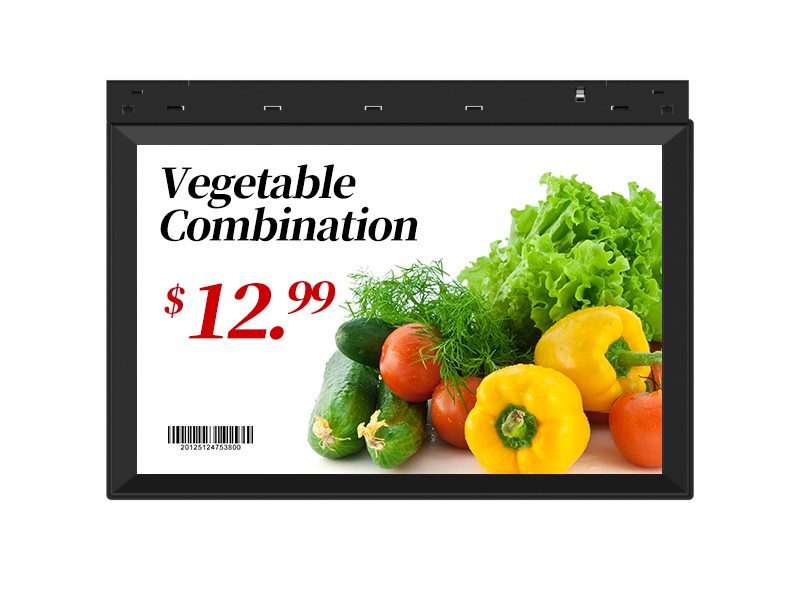
This breakdown shows how each piece scales and how to build a realistic per-store budget. For the paper-versus-ESL payback math see ESL vs paper labels; to compare suppliers on total cost, see the ESL manufacturer buyer’s guide.
The Four Cost Components
Every ESL deployment has four budget lines, and only the first is the one buyers usually ask about.
| Component | What it covers | How it scales |
|---|---|---|
| Labels | The e-paper tags themselves. | By size, color and quantity. |
| Base stations | Gateways / access points that drive the labels. | By floor area and ceiling height. |
| Software / platform | Management console and AI engine. | Per store / subscription. |
| Integration & install | ERP/POS connectors, mounting, training. | One-time per rollout. |
What Drives Label Price?
Three factors dominate: size, color and quantity. A 1.54″ hook tag costs far less than a 10.2″ display; black/white/red is standard while full 7-color costs more; and price per label falls sharply at volume — so always request pricing at your quantity and watch minimum order quantities. Environmental rating (cold-chain sealing) and battery capacity add further cost where needed.
| Label attribute | Lower cost | Higher cost |
|---|---|---|
| Size | 1.54″–2.13″ hook / shelf tags | 7.5″–13.3″ large formats |
| Color | Black / white / red | Full 7-color e-paper |
| Quantity | High volume, above MOQ | Small orders, below MOQ |
| Environment | Standard indoor (IP54) | Cold-chain / sealed (IP67, sub-zero) |
How Many Base Stations Do You Need?
Gateways are sized by coverage, not SKU count. One base station covers a radius that shrinks with mounting height — a unit on a high ceiling reaches a smaller floor footprint than its rated range. A large warehouse therefore needs more gateways than a compact store of the same SKU count. The vendor sizes the exact number from your floor plan and ceiling height during a site survey; estimate yours with the base station coverage planner, and check the capacity side too — update speed can demand more gateways than coverage alone.
Build a Realistic Per-Store Budget
Start from SKU count and store size, then offset against the labor and paper you stop spending. Labels scale with SKUs, gateways with floor area, software with store count, and install is one-time. The software line has its own structure — licence, deployment, server, annual maintenance and support — broken out in cloud versus your own server. A worked structure:
| Line | Driver | Planning note |
|---|---|---|
| Labels | One per priceable position (SKU facings). | Mix sizes: small mono for center store, color for fresh/feature. |
| Gateways | Floor area ÷ per-unit coverage. | Add coverage for back rooms if you label them. |
| Software | Per store, often annual. | Where POS/ERP integration and AI live. |
| Install | Rails, clips, binding, training. | One-time; varies by shelf type. |
| Offset | Labor + paper + error cost removed. | This is what turns cost into payback. |
The ROI calculator turns those inputs into a payback period and multi-year net savings. For which store formats pay back fastest, see the ROI table in what electronic shelf labels are.
One-Time vs Recurring: Read the Whole Five Years
The sticker-price trap is comparing an ESL’s upfront cost against a paper tag’s per-unit cost. The honest comparison is total cost of ownership across the hardware’s five-to-ten-year life: mostly one-time hardware and install for ESL, plus a software subscription, against paper’s low unit cost that recurs every week in labor and printing forever. And there is a second lever unique to ESL — the platform choice. A closed system can force a full rip-and-replace at upgrade time; an open one lets you reuse labels. We unpack that in open vs closed ESL systems.
Want a real figure for your network? Run the ROI calculator or request a custom quote and we will size labels, gateways and payback for your stores.