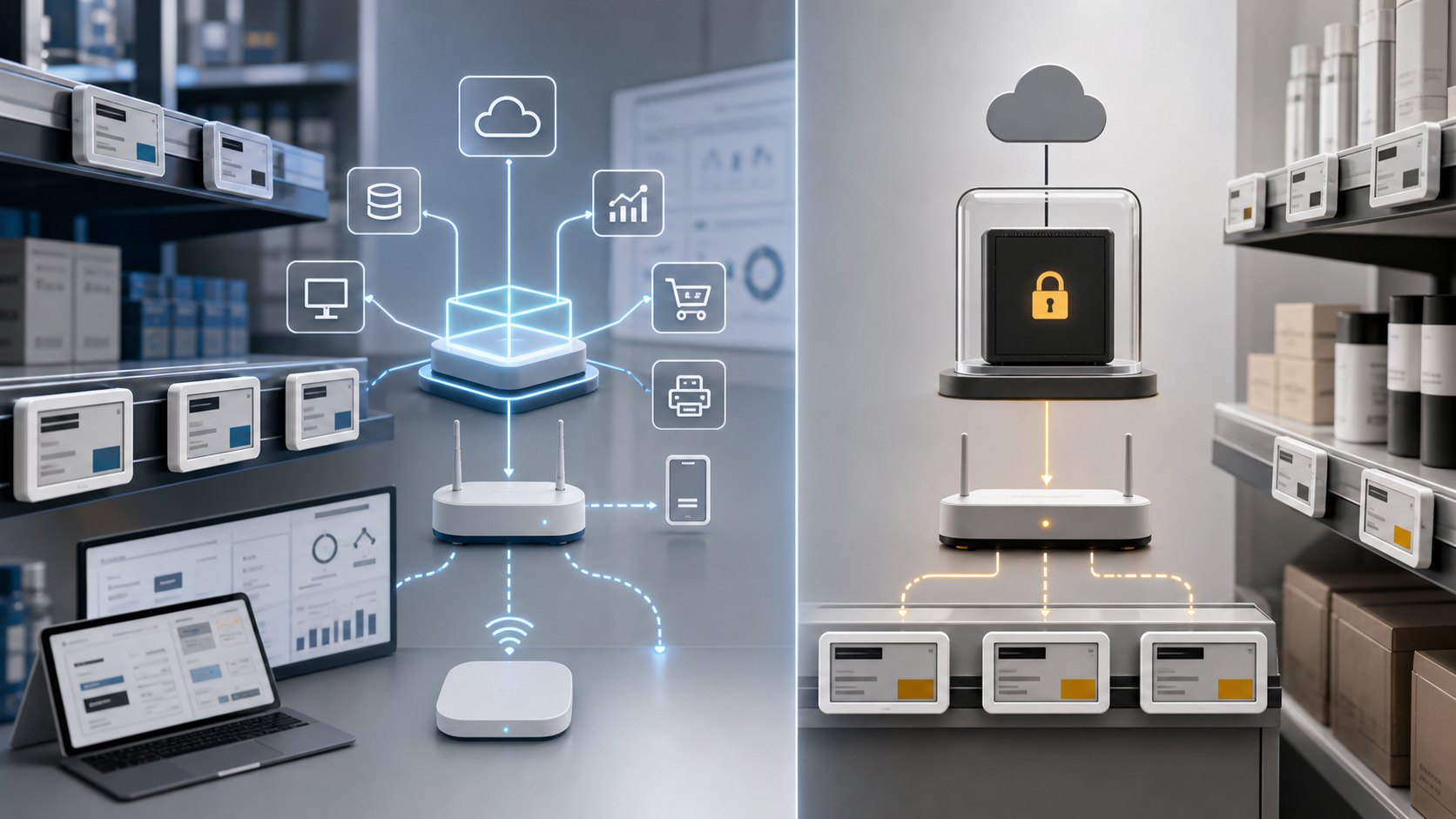
We build ESL infrastructure for a living, including open middleware, so we have a position in this debate — we state it at the end. But the argument only matters if the analysis before it is honest, because the closed model has genuinely earned its dominance. This article lays out what “open” really means at the shelf edge, why the industry’s leading players formed two camps, what each model is actually good at, and why the arrival of AI agents changes the calculation.
What Does “Open” Actually Mean for an ESL System?
Why is there no true “open source” in ESL?
Unlike AI, where open means published model weights, no ESL vendor publishes its firmware or protocol stack — the wireless protocol is treated as core technology. So “open vs. closed” at the shelf edge is not a binary but a ladder with three rungs, and a system can be open on one rung while staying firmly closed on the others.
| Layer | What “open” looks like | Industry reality in 2026 |
|---|---|---|
| 1. Wireless protocol | Standard radio protocol any certified vendor can implement — today that means the Bluetooth SIG ESL Profile. | Almost nobody opens this layer voluntarily; proprietary 2.4 GHz and optical systems dominate installed fleets. The Bluetooth standard, released February 2023, is the exception path. |
| 2. API & integration | Documented REST/MQTT endpoints the retailer can call from its own software, cloud or on-premises. | Most vendors “have an API,” but many are proprietary interfaces bound to the vendor’s own cloud; some vendors require their own software suite — cloud or on-prem — to run the labels at all. |
| 3. Hardware compatibility | Middleware that drives labels from multiple brands through one console, with SDK access for the retailer’s developers. | The least open layer: vendors that offer an API often still withhold SDKs or attach demanding commercial conditions to them, keeping mixed-brand estates impractical. |
Framework: AiESL. Bluetooth ESL Profile: Bluetooth SIG press release, February 2023.
A useful one-line definition falls out of the ladder: an open ESL platform is one a retailer can operate from its own systems — standard protocol, callable API, exportable data, multi-brand hardware — while a closed ESL ecosystem is one the retailer must operate from the vendor’s systems. Every real product sits somewhere between the two poles.
What the AI Industry’s Open-vs-Closed Split Teaches Us
How did the same debate play out in AI?
AI ran the open-vs-closed experiment at high speed, and both models won something. Closed model providers — OpenAI with GPT, Anthropic with Claude — kept weights proprietary and delivered polished, consistent, fast-improving products that dominate direct usage. Open-weight models — Meta’s Llama, DeepSeek, Alibaba’s Qwen — gave up that control and got something else: an ecosystem. Thousands of companies fine-tune them, embed them, and undercut closed pricing with them; DeepSeek’s low-cost releases in particular forced repricing across the whole market.
| Dimension | Closed AI (GPT, Claude) | Open-weight AI (Llama, DeepSeek, Qwen) |
|---|---|---|
| Product experience | Consistent, tuned end-to-end by one vendor. | Varies by integrator; excellent to poor. |
| Iteration | Fast, centralized, opaque. | Distributed; community ports, quantizes, fine-tunes. |
| Pricing power | Vendor sets the price. | Competition collapses prices toward compute cost. |
| Control & data | Runs in the vendor’s cloud, on the vendor’s terms. | Can run in the buyer’s own infrastructure. |
| Ecosystem | Built by the vendor, gated by the vendor. | Built by everyone, owned by no one. |
Retailers have lived this trade-off before in another form: iOS versus Android. Apple’s closed integration bought consistency and premium margins; Android’s openness bought overwhelming volume share and every price point. Neither “won” outright — but notice where each wins. Closed wins where the in-box experience is the product. Open wins where the product must plug into everything else. The shelf edge is moving from the first category to the second, and the mechanism is the AI agent — which we come to below.
Why Did the ESL Industry Form Two Camps?
How did the closed camp get built?
The closed ecosystem was not a conspiracy; it was the rational design for how ESL was sold for twenty years. The European pioneers — VusionGroup (formerly SES-imagotag) and Pricer — grew up selling to grocery chains on multi-year contracts, where the vendor delivers tags, gateways, software and support as one accountable package. Their wireless systems were proprietary by necessity (no standard existed) and their business models came to rest on recurring software and service revenue layered on the hardware estate. When you sell reliability to a 1,000-store chain, vertical integration is a feature: one throat to choke, one system to certify, one vendor to blame.
Why did a second camp emerge at all?
Later entrants — many of them Chinese manufacturers — faced incumbents holding exactly those long contracts. The doors that remained open were price, flexibility, and the customers the incumbents’ model served badly: retailers who refuse to put their pricing stack inside a vendor’s cloud. In our experience talking to chains across markets, this instinct is widespread and getting stronger — retailers increasingly want to develop and integrate on their own terms, treating shelf labels as one device class inside their architecture, not as a parallel vendor-run system. The catch: building that integration yourself typically takes about a year of software development before chain-wide rollout. That year is the closed model’s real moat — and compressing it is precisely the job of open middleware.
What made 2023 a turning point?
In February 2023 the Bluetooth SIG released the ESL Profile, the first standardized wireless protocol for shelf labels — developed, notably, with participation from SES-imagotag and Qualcomm among others. When the leading closed vendor helps write the open standard, the industry is acknowledging where gravity points: silicon vendors now ship standard ESL radio support, and a certified-interoperable tag market becomes possible in a way proprietary radio never allowed. Standards do not flip industries overnight — installed proprietary fleets will run for years — but the protocol layer, the hardest rung of the ladder, now has an open path.
Source: Bluetooth SIG, February 2023.
The Honest Trade-Off: What Each Model Is Actually Good At
Any fair scorecard has to start by conceding that the closed model just delivered the largest ESL deployment in history. Walmart’s rollout across roughly 4,600 US stores — the project that reshaped global e-paper shipments — was executed as a single-vendor ecosystem, and it is hard to argue with a working deployment of that scale.
| Criterion | Closed ecosystem | Open platform |
|---|---|---|
| Accountability | One vendor owns every failure — simplest governance. | Responsibility spans middleware and hardware parties; contracts must be written well. |
| Reliability at extreme scale | Tuned end-to-end; proven in the industry’s biggest rollouts. | Standard protocols are young at mega-scale; maturing quickly. |
| Speed to first store | Fast — the vendor has done it hundreds of times. | Depends on integration scope; middleware narrows the gap. |
| Switching cost | High by design — hardware, software and cloud move together. | Low by design — labels are replaceable parts, not commitments. |
| Procurement leverage | Weakens after the first contract; renewals negotiate against sunk hardware. | Persistent — multi-brand support keeps every renewal competitive. |
| Data & integration | Shelf-edge data accumulates in the vendor’s system. | Data lands in the retailer’s own stack, feeding its analytics and AI. |
| Future flexibility | Bound to one vendor’s roadmap. | Bound to standards and your own architecture. |
Summarized in one sentence: closed optimizes the next rollout; open optimizes the next decade. For the past ten years the industry bought rollouts, and closed deservedly won. The reason we think the next ten look different is not hardware — it is who, or what, will be operating the software.
What AI Agents Change
Why does the software UI stop mattering?
Our trend judgment: as retailers deploy AI agents that operate systems directly, the vendor’s user interface stops being the product, and the callable API becomes the product. A pricing agent that executes a markdown strategy does not care how elegant the vendor’s dashboard is; it cares whether there is a documented endpoint to set a price, read a shelf state, and subscribe to events. Retail software is heading where developer tools already went: the humans set policy, the agents do the clicking. In that world, “you must use our software suite” translates to “your agents cannot work here.”
What does MCP have to do with shelf labels?
The AI industry has already shown the mechanism. In November 2024 Anthropic released the Model Context Protocol (MCP), an open standard that lets AI agents call external tools through a uniform interface; within a year it was adopted by OpenAI and Google, donated to a Linux Foundation body, and surrounded by more than ten thousand public servers. The lesson is brutal and simple: tools that expose standard interfaces get orchestrated into agent workflows; tools that do not get bypassed. There is no reason shelf-edge infrastructure will be exempt. An ESL system whose only interface is a vendor UI — or a proprietary API without documentation, SDK or export rights — is a tool an agent cannot pick up.
Sources: Anthropic — Introducing the Model Context Protocol; Anthropic — Donating MCP to the Agentic AI Foundation.
Who ends up owning the data?
The deeper stake is data sedimentation. Every price change, markdown, promotion response and stock event at the shelf edge is training signal for the retailer’s own AI — the systems that will run dynamic pricing, forecasting and replenishment. If that data accumulates in a vendor’s cloud, the retailer’s AI learns less than its label supplier does about its own shelves. Retail AI commerce is already moving toward agent-readable inventory, loyalty, payment and fulfillment data: Walmart’s Google integration exposes product and store context inside Gemini, while Walmart technology leaders describe open partnerships as central to the strategy. Compliance pressure points the same way. The EU Digital Services Act covers online marketplaces and emphasizes platform transparency and accountability. For shelf-edge infrastructure, the implication is practical: pricing-agent systems need traceable, auditable, exportable data flows. Closed data paths are becoming a risk conversation, not just an architecture preference.
Sources: PYMNTS — The New Storefront Is the AI Conversation; Modern Retail — Walmart says open partnerships are central to its AI strategy; European Commission — Digital Services Act.
Six Questions to Ask Any ESL Vendor in 2026
Openness is not only an integration question — it decides whether anyone else could ever take the system over. The practical version of that, including software escrow and hardware portability, is in cloud versus your own server.
- Protocol: Do your tags support the Bluetooth ESL standard, or only a proprietary radio? What is the migration story?
- API: Are there documented REST or MQTT endpoints for price updates, template pushes and state queries — callable from my systems, not just your cloud?
- SDK: Can my developers get the SDK — and under what commercial and legal conditions?
- Data: Can I export all shelf-edge data, continuously, into my own data platform? Who owns it contractually?
- Hardware freedom: Can your software — or a middleware layer — drive another brand’s labels? Can another system drive yours?
- Agent readiness: If my AI agent needs to change 10,000 prices at 3 a.m., what does it authenticate against, and where is that documented?
A vendor with good answers to all six is safe to buy from in either camp. A vendor with poor answers is asking you to bet your shelf edge on their roadmap — for the length of the hardware’s life. Our cost guide explains why that bet spans seven to ten years, and our vendor comparison covers the landscape.
Where We Stand
We build for the open end of the ladder, and this is why. AiESL’s platform is open middleware: one console that drives labels across five-plus hardware brands, exposes standard APIs for the retailer’s own software and agents, and leaves the data where it belongs — in the retailer’s stack. We think the closed model earned the last decade, and we think the agent decade rewards the opposite architecture. If you are weighing the trade-off for your own stores, see the hardware we support, run the ROI calculator, or talk to us — including if you just want an honest second opinion on a closed-ecosystem quote.
Sources
- Bluetooth SIG — Bluetooth SIG Introduces Wireless Standard for Electronic Shelf Label Market (Feb 2023)
- Anthropic — Introducing the Model Context Protocol (Nov 2024)
- Anthropic — Donating the Model Context Protocol to the Agentic AI Foundation
- PYMNTS — The New Storefront Is the AI Conversation
- Modern Retail — Walmart says open partnerships are central to its AI strategy
- European Commission — Digital Services Act
- RUNTO — Global ePaper Market Analysis Quarterly Report, Q1 2026
- CNBC — Walmart digital price labels in every US store by end of 2026